
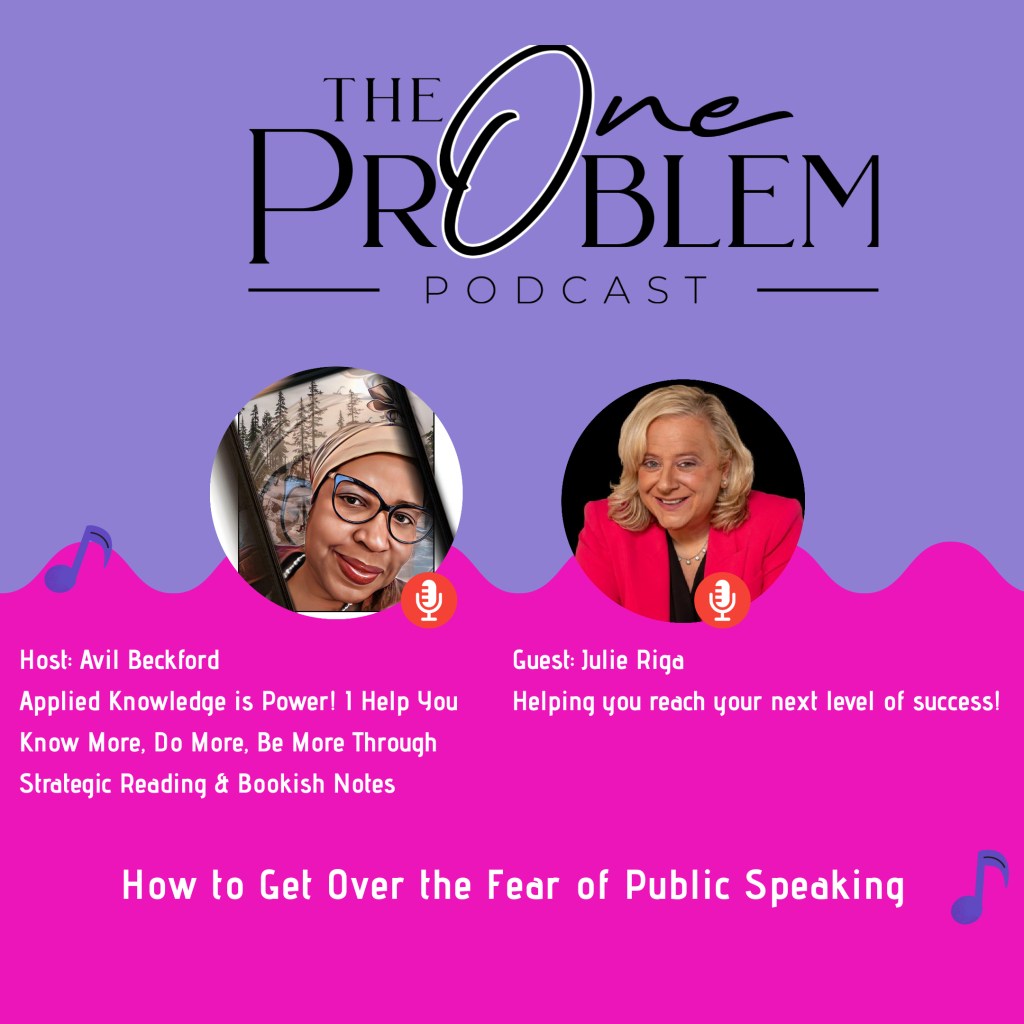
Hi there. My name is Avil Beckford. I'm the founder and the host of The One Problem podcast. There are tons of problems in the world. We will not get overwhelmed. We're going to tackle them one problem at a time. As has been the case, most of the people come on this podcast, I have some prior relationship with them.
Today's guest is Julie Riga. I’m in a business club with her. She is a readiness coach. And what she does is take you to the next level of your success. Over to you, Julie.
Julie Riga
Thank you, Avil. Thank you for having me here today, and I'm so excited to be talking about the problem of the day. And that is the fear of public speaking. In speaking, everyone gets jitters, and around 75% of the population struggles with the fear of public speaking. There are moments before you speak where your heart races, you start sweating, your knees are wobbling, and your body is saying, wow! Something big is happening, and then we fear it. We avoid getting into the spotlight.
So how do we solve this problem? And so how we're going to solve it today is unpacking the idea of being ready and getting ready for that opportunity, because as entrepreneurs, as business owners, as corporate executives, we have many opportunities to use our voice. If we want to use our voice well, we need to be ready. We need to say yes and have the confidence to get on the stage. And so many of us say no to opportunities. Instead of saying yes to opportunities, because we're not ready.
The One Problem with Julie Riga
So the problem we're solving today is, how do you get ready to say yes? So I have created a system called BEFORE. It's an acronym BEFORE, and I walk through these ideas to help you become a better speaker. The first one is, Be courageous. So, in entrepreneurship, in job interviews, tapping into our courage is going to be the anchor for you to say yes to opportunities. We want to reflect on those moments of time where we felt courageous and tap into the strength that we had in those moments.
Julie Riga
So, remember a time where you had to do something, where you had to rely on your courage to do something, whether that be to jump out of an airplane, to get up on a pair of skis, to ride a horse or do something that you've never done before. What did you do to get on to that path, to do something that was difficult?
And so the next thing is to Envision your success. So before you get on the stage or before you have the job interview, envision your success. Think about you, and how it looks when you are successful and be able to envision it in your body.
Have you read or watched?
- Kelly Wagner: Mastering Marketing: Tips for Small Business Success
- Mastering Struggle: Insights from Siera Sambrosky | The One Problem Podcast
- 3 Empowering Questions to Overcome Stuckness with Caroline Ferguson
- Barbara Feigin: Journey Breaking Through Career Barriers
- Impactful Presentations: Overcoming the Fear of Vulnerability with Meridith Grundei
- Overcome Sunday Scaries with Jess Harrington, The One Problem Podcast Episode
- Navigating Insomnia, Anxiety, and Stress with Stephanie Dalfonzo
- Janice Shokrian: Mastering Time Management Journey to Success with Tausi Pillows
- Kadine Cooper, Executive Coach and Job Search Advisor
- Jennifer Mrozek Sukalo, Transformational and Wellbeing Expert
- Brenda Pearson: Crush Impostor Syndrome & Boost Confidence NOW!
- Crush Chaos in Life & Work, Master the CHAOS Model with Vitality Coach LaChelle Adkins
- Mastering Difficult Conversations: Expert Tips from Madeline Schwarz
- Boost Your Productivity with Professor Margo Berman’s 5-Step Process
- Overcoming the Gender Confidence Gap with Sheena Yap Chan
- LaRae Quy, Author of Secrets of a Strong Mind
- Laura Flessner, Innovation & Leadership Coach
- Jennifer Regular, The Soul Illuminator
- Judith Sherven, Executive Coaching for the Brightest and Best
- Jackie Lyles, C Level Growth Strategies to Maximize Sales
Feel what it's like to actually go through that process, and in your mind, envision what that's like. So you can practice that. So when you do it, you will be more ready.
And so then we want to Formulate our why story. Our why story is so important because it gives us energy into speaking, because speaking is really just an energy exchange. So when we level up our energy, and show up authentically and with our full self. Then that energy, it's contagious. The audience picks up on the energy, and they want more of it, and they're listening, and you've captured them. So that is so important. And that energy comes from your why. You have somewhere deep inside you a real why, why you're doing what you're doing, and if it's purposeful, if it's meaningful to you.
You show that to your audience, and your audience will also find it very meaningful, because you're so passionate about what you're talking about. Your passion will come through if you can formulate that story. And these are things we're doing to prepare. Then we want to look at the audience Outcomes. So, beginning with the end in mind, what do you want your audience to walk away with?
How do you want them to really experience you and what you're talking about? What do you want them to walk away with and then really thinking about tailoring your speech to that outcome that you want them to have? And really thinking about that before you get on the stage and reminding yourself of those things, are going to help you become a better speaker.
Julie Riga
And then the R, Reflecting on your authenticity. What are the personal insights that you can share that are going to resonate with your audience? How are you going to bring them into your world? And how are you going to connect with them? And that's about you storytelling from a personal perspective. It's about you really thinking about how you're going to connect with the people that are there in the room with you. And so tapping into those stories, connecting those stories to the content.
Connecting the content to the people that are in the audience, and custom making those experiences for people are really going to help you bring those people in, and especially when you're at a job interview. You want them to understand who you are. You want to be as authentic as possible, and you want them to like you. A lot of these things are so important for the listener to trust you and like you because they're going to receive what you say much more than if they don't. And you're going to give them that by your authentic stories that you're telling.
And the last thing that I want you to think about is to Elevate your delivery. This is really the skill of presenting. How will you elevate your delivery? And how are you practicing that? Because that will help you become a better public speaker. It will help you gain the confidence and the acumen that you need to be sitting in these spaces. And so what do I mean by that? I mean the body language you're using.
Are you gesturing? Is the audience able to see you? If you're on a zoom call? Do you fill the screen? Are you creating a presence on camera? Are you? Do you have the right lighting? Do you have the right microphone? What are you doing to level up and then articulating your speech?
Julie Riga
Do not speak too fast because too fast is not good. Your audience will not have a chance to catch up on what you're saying, because you will have spoken too fast. And I think that it's most important not to read too much. You can have notes, but don't read your message. Talk from the heart, have your talking points, but don't read everything because your listener will know that. They will pick up that you're reading, and they'll be bored. They could listen to an audio book if they want to listen to somebody read something.
So be authentic. Don't type everything out, have some talking points. Pay attention to your breathing and convey the confidence that you need. All these things are going to help you become a better communicator. And we need to practice. We need to get to a place where we're fluent in our ability to speak publicly, and when you do, you will conquer the fear of public speaking. Over to you.
Avil Beckford
Thank you so much. I love the acronym BEFORE.
And it's so interesting when you're talking about don't read. One of the worst interviews I did was with someone who wrote out what they wanted to say. I usually give people the questions before, and she wrote out her response and she read it. I didn't really know what to do. And you could tell she was reading it, so people weren't engaged. So thank you so much, Julie. This was awesome.
Julie Riga
Thank you so much for having me.
Next Steps
Wondering what to do next, you can do all or some of:
-
Buy my new book, Leadership Reading: Spilling the Tea on How Top Leaders Read
-
Subscribe to my YouTube Channel
-
Join the Art of Learning Membership Site
-
Download Unlock Your Genius Power Reading Tips Sheet
-
Buy me a cup of coffee!
If you want access to my Bookish Notes, please consider joining my membership site, the Art of Learning.
This post contains affiliate links and The Invisible Mentor® may earn commissions for purchases made through links in this post. For more details see here. Thank you so much for your support!
