
A Mind For Numbers: How to Excel at Math and Science by Barbara Oakley is the 22nd book I read in the Read 30 Books in 30 Days Reading Challenge. This is an excellent book, but I read her other book, Learning How to Learn and there’s a lot of overlap.
If you’re not a joiner, buy my e-book, Read 30 Books in 30 Days Like Francis Bacon instead?
A Mind For Numbers Learning How to LearnMindshiftRead 30 Books in 30 Days Like Francis Bacon
Book Bite: Procrastination robs you of time. When you have enough time, you can build learning structures. When you think about something you don’t like, it activates the insular cortex which is the pain centre of the brain. To stop procrastination, get going.
Participating in the read 30 books in 30 day reading challenge was an interesting experience for me. This reading challenge is about tackling your pile of to-be-read nonfiction books. It’s also about stretching yourself – having a growth mindset.
Now that I’ve decided to read 100 books in 100 days, I have to make sure that I’m reading books across multiple disciplines. I have close to 17,500 books in my Kindle app, so I have many options. While experiencing the read 100 books in 100 days I don’t want to hear myself saying, haven’t I read a book like that already?
What is A Mind For Numbers: How to Excel at Math and Science by Barbara Oakley About?
Have you ever taken a course or read a book on how to learn? I’m serious. Every professional needs a toolkit filled with effective reading and learning strategies. This book goes a long way in allowing you to build that toolkit.
If you’re interested in learning and memory, A Mind for Numbers or Learning How to Learn, both by Barbara Oakley are excellent options for you. Learning can be an adventure, believe it not. That’s the way I think about reading books.
3 Steps to Powerful Reading
- Picture walk: Inspect the chapter before you read it. I advise you to inspect the entire book before you start reading it.
- Read with care: Pay attention to what you’re reading.
- Active recall: Practice recalling what you learned. It’s like testing yourself.
Do a picture walk of a chapter before you start to read it. Look at the following:
- Pictures, diagrams, and any images.
- Bold and italicized words.
- Section headings
- Summaries.
- Questions at the end of the chapter.

Zoning out is helpful in problem solving.The brain operates in two modes – Focused and diffuse mode. The brain moves through focused and diffuse mode. Diffuse mode uses a different part of the brain than when you’re focused. To switch from focused to diffuse mode, start working on a completely unrelated activity – take a nap, walk, exercise at the gym. Walking spurs creativity.
Focused mode: Direct approach to problem solving using rational, sequential, analytical approach. Associated with the brain’s prefrontal cortex. Turn your attention to something. It’s difficult to pay attention for long periods of time.
Diffuse mode: Gain insight on a problem you’re struggling with. You can make connections between ideas when your brain is in diffuse mode. It’s associated with big-picture perspectives. Diffuse mode thinking happens when you relax your mind and allow it to wander.
When you’re distracted from a problem, the diffuse mode can look at the big picture to solve the problem. Focus on the problem, take a break, then focus on the problem again. Sleep is vital to learning and memory.
Remembering Information
Testing yourself is a powerful learning experience. To remember, create a metaphor or analogy. People learn by trying to make sense out of the information they perceive. Deliberate practice on the toughest aspects of the material can help to lift the average brain into the realm of those who have more ‘natural’ gifts.
When you change how you think you make significant changes in the brain. Reshaping your brain is under your control. The key is patient persistence. Work with your brain’s strengths and weaknesses. Simplify and personalize what you’re learning.
Create conceptual chunks, which are mental leaps that unite separate bits of information through meaning.
“Good chunks form neural patterns that resonate, not only within the subject we’re working in, but with other subjects and areas of our lives. The abstraction helps you transfer ideas from one area to another.”
Basic Steps to Form a Chunk
Essentially, chunks are pieces of information that are bound together through meaning.
- Focus on the information you want to chunk. When you first learn something you make neural patterns and cement them with pre-existing patterns.
- Understand the basic idea you’re trying to chunk – synthesizing.
- Gain context so you can see how and when to chunk. See how newly formed chunks fit into the bigger picture.
Steps to Building a Powerful Chunk
- Work a key problem all the way.
- Do another repetition of the problem paying attention to the key process.
- Take a break. Study other aspects of the subject.
- Work the problem before you go to sleep.
- Do another repetition. Work the problem again the next day.
- Add a new problem and start working on it.
- Do ‘active’ repetition – mentally review problem steps in your mind.
Retrieval Practice
Retrieval practice is more effective than re-reading. Mentally retrieve key ideas. Before you go to sleep retrieve what you learned that day. Recalling information helps you to learn it more effectively.
Interleaving
Interleaving is the practice of working on a mixture of different kinds of problems requiring different strategies.
Procrastination
What is procrastination? It’s putting off things for later. Procrastination robs you of time. You can use the Pomodoro Technique to stop procrastination. When you have enough time, you can build learning structures. When you think about something you don’t like, it activates the insular cortex which is the pain centre of the brain. To stop procrastination, get going.
The Pomodoro TechniqueThe 80/20 Principle
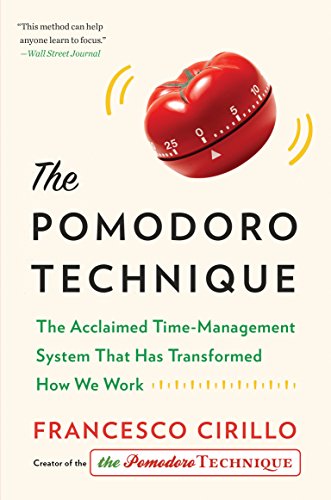
Pomodoro Technique
- Shut off all distractions. That means turning off your phone, TV and computer.
- Set the timer for 25 minutes. (I downloaded a paid Pomodoro app to my phone and I also have a kitchen time app.)
- Focus on a task for 25 minutes.
- Give yourself a reward for five to 10 minutes. Get into diffuse mode.
If the task takes more than 25 minutes, don’t sweat it, you could always do another Pomodoro. Your mind may wander during the 25 minutes, just refocus it. If thoughts come to you while doing your Pomodoro, jot them down so you won’t forget them. Then go back to the task at hand. If you’re in a state of flow when the 25 minutes are up, you can continue to work.
When you stop, reward yourself. Do something that’s very different from the task you were focusing on. Rest the area of the brain you were using to do the task. Work on only one task at a time when you’re doing Pomodoro. If you complete a task before the 25 minutes are up, you can start another task then. NO MULTITASKING. Multitasking does not work, you can only focus on one task at a time.
Set your timer for your break. Taking a break puts you in diffuse mode which helps your learning.

Have you read?
These Two Essential Books Will Skyrocket Your Career Success
Building Habits
Habit is an energy saver for you. It allows you to free your mind for other activities.
4 Parts of Habit
- Cue: Trigger that launches you into the mode to do something.
- Routine: The routine, habitual response your brain uses to fall into when it gets the cue.
- Reward: Habits develop and continue because they reward us.
- The Belief: Habits have power because of your belief in them.
Final Thoughts: A Mind For Numbers: How to Excel at Math and Science by Barbara Oakley
If you’ve never read a book on how to learn this is a good place to start. However, I preferred Learning How to Learn, another book by the author. I’ve read over a dozen books on reading, learning, and memory because they’re topics I’m interested in.
Have you read?
Confident Career Woman Book 1: Read 30 Books in 30 Days Reading Challenge
Why Not You Book 2: Read 30 Books in 30 Days Reading Challenge
Own a Business? You Don’t Need Everyone, You Need 1000 True Fans
You’re Unstoppable: Learn How to Be a No-Limit Person
Start Taking Steps Now to Crush It Post Isolation
Go Suck a Lemon: How Emotionally Intelligent Are You?
Way of the Athlete: Learn the Art of Focus, Discipline and Achievement from Professional Athletes
Act Now: Do You Act Quickly on Opportunities Or Take Your Time
Is It Really a Good Time to Be a Girl, Ladies Please Chime In!
You Are a Badass by Jen Sincero Will Help You to Get Through Isolation
The Subtle Art of Not Giving a F*ck by Mark Manson, Book Review
Book Review: Content Marketing Strategies to Attract an Engaged Audience
One Million Followers: How I Built a Massive Social Following in 30 Days, Book Review
Book Review – Patterns in Nature: Why the Natural World Looks the Way It Does
Biomimicry: Innovation Inspired by Nature, Book Review
Book Review – The Outsiders by William Thorndike
Little Brand Book by Kalika Yap, Book Review
Book Review – The Innovation Stack by Jim McKelvey
How Avil Can Help You!
I invite you to Join the Performance Accelerator Plan that walks you through the process of learning key skills and more. You’ll be reading books to build skills and develop intercultural awareness. Get more reading and learning tips here.
In December 2020, I published two books on Amazon. I would greatly appreciate your support if you bought my two short e-books Read 30 Books in 30 Days Like Francis Bacon and Performance Accelerator Plan: Guide to Learning and Mastering Key Skills for the Future.
Read 30 Books in 30 Days Like Francis Bacon is not about speed reading. It’s about approaching every book differently and reading only the sections that align with your purpose.
The Performance Accelerator Plan book is a stripped-down version of the paid reading challenge of the same name. Obviously, you won’t get all the resources that come with the program that I sell on my website. But if you are a self-directed learner, it will help you tremendously.
If someone clicks on a link and buys something from Amazon, the company will pay me a very small commission.
