
Introduction: Perennial Seller by Ryan Holiday
Perennial Selle Although I enjoyed Perennial Seller by Ryan Holiday, at the end, you do not know what to do next, because he doesn’t tell you. The average person needs a call-to-action. After reading the book, you know that you need to create great work whatever that is for you. It’s about becoming better at your craft.
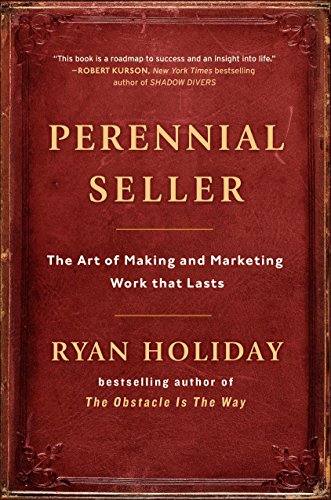
For a writer, it’s focusing on writing a perennial bestseller. For a salesperson, it’s about understanding sales strategies, and crafting one for yourself. In the book, Ryan Holiday mentions that being the only one is better than being the best. When you’re the only one, you don’t have any competition.
One of the things I invite readers to do, is that when learning a skill, read five to 10 very good books on the topic. But it doesn't stop there. Pull the processes or models, then consolidate them to create something new, something that’s unique to you.
How can you create something that stands the test of time? And how do you create something that has impact and survives. To create something epic, you cannot expect immediate payoffs and instant gratification.

Have you read?
The Obstacle is the Way by Ryan Holiday, Book Review
How to Grow My Small Business with Growth Hacking Techniques
Summary: Perennial Seller
Definition of a Perennial Seller
“Products that have found continued success and more customers over time. People return to them more than once and recommend them to others. They are timeless, dependable resources and unsung moneymakers, paying like annuities to their owners. Like gold or land, they increase in value over time because they are always of value to someone, somewhere…. In other words, classics stay classic and become more so over time. Think of it as compound interest for creative work.”
Art of the Perennial Seller
- How they work.
- What goes into them.
- Why they matter from a personal and business standpoint.
It’s important to strive for longevity.
How to Make Something Last
Perennial success is the result of the right decisions. The right priorities, and the right products.
- Right mindset.
- Right process.
- Right set of business strategies.
We’re all selling ideas. Spend time creating work that matters.
To Create Work That Has Lasting Impact
“To be great, one must make great work, and making great work is incredibly hard. It must be our primary focus. We must set out, from the beginning, with complete and total commitment to the idea that our best chance of success starts during the creative process.”
Pre-Work Matters
- Conceptualizations.
- Motivations.
- Product fit with the market.
- Execution.
Austin Kleon once said,
“People want to be the noun without doing the verb.”
Relevant Quotes
Phil Libin, the cofounder of Evernote, has a great quote:
“People [who are] thinking about things other than making the best product never make the best product.”
We’re not just talking about making something that is the best for the hell of it.
As legendary investor and Y Combinator founder Paul Graham explains,
“The best way to increase a startup’s growth rate is to make the product so good people recommend it to their friends.”
To create great work, what's required is a need. I need to do this. I have to. I can't not do this.
Have purpose for why you want the outcome. And why you're willing to do the work. Purpose can be anything but it must be there. You're building something where nothing was before. When creating, you’re giving something to the world. You're solving a problem.
- Why are you creating?
- What is your motivation?
Your responses will determine how successful you will be. Begin your project with the right intent. What are you willing to sacrifice to create your work? Have a willingness to trade off something.
Creating great work is like running a marathon. However, when you cross the finish line, instead of getting a medal, you're taken to the starting line of another marathon. You’ll experience what Seth Godin refers to as the ‘Dip’ while working on your product. And you’ll find yourself asking, “Is this worth it anymore?”
If what you want is to make money, then the path of the perennial seller is not for you. Creating something that can change the world (change lives) and do so for decades requires reverence for the craft, respect for the medium, and real patience for the process. Patience with the long view which you evaluate your work.
“Focus on the things that don’t change.”
Ernest Hemingway rewrote the first part of A Farewell to Arms 50 times trying them like the pieces of a jigsaw puzzle until one finally fit. Additionally, it’s reported that Jack Kerouac wrote On the Road in a three-week, drug-fuelled blitz. What is not well-known is that he spent six years editing and refining it until it was ready. A writer has to get it right.
Creative ideas evolve over time with reflection and collision of disparate ideas. Small, even silly ideas can become big important work if you invest enough time in them. Great work is created by the process.
Test your project early and test often. Mediocre ideas sometimes contain seeds of better ideas buried inside.
Here’s the sequence to write a great book.
- Conversation at the dinner table about the idea.
- Write an article.
- The write the book.
Getting feedback is essential and also dangerous. Anything can be a double-edged sword. Getting feedback is about finding the germ of a good idea, and then making it a great product through feedback and hard work.
A small publisher has the slogan, which resonates with Ryan Holiday:
“Find your niche, and scratch it.”
Creators need to ask,
- Who is this thing for?
- What will your target audience think about this?
- Does it have a purpose?
- And does it add value to the world?
- How will it improve the lives of people who buy it?
Ryan Holiday got the following advice from a mentor.
Work should either be,
- Entertaining.
- Extremely practical.
Do something for people, to help them do something — and have that be why they will talk about it and tell people about it. The more important and perennial, a problem, the better chance the products that address it will be perennial as well. The bigger and more painful the problem you solve, the better, its cultural hook, and the more important, and more lucrative your attempt to address it can be.
Creator of the Project Should Try to Answer the Following Questions
- What does this teach?
- What does this solve?
- How am I entertaining?
- What am I giving?
- What are we offering?
- What are we sharing?
- What are these people going to be paying for?
Srinivas Rao, a writer says, only is better than best.
“Be the only one doing what you're doing.”
Be bold, brave, or brash instead of being a derivative of something.
Higher and more exciting standards for every project should force you to answer:
- What sacred cows, am I slaying?
- What dominant institution, am I displacing?
- What groups am I disrupting?
- What people am I pissing off?
Make something that people rave about and become part of their lives. Buried insights are found in great works, not put there in the first pass. Work is unlikely to be layered if written in a single stream of consciousness. Deep complex work is built through a relentless, repetitive process of revisitation.
An agent once said,
“Spend three times longer revisiting your manuscript, than you think you need.”
Be the CEO of your work. All responsibility and leadership falls on you. You have the vision of what your project – the thing should be. You need an editor because you're too close to the project. Bring people who are objective to look at your work. What are the chances that I'm right and everyone else is wrong.
Neil Gaiman commented.
“Remember: When people tell you something’s wrong or doesn’t work for them, they are almost always right. When they tell you exactly what they think is wrong and how to fix it, they are almost always wrong.”
Only you can fix the problems, but you need others to point them out. Ask yourself:
- What was I trying to make?
- Did I get there?
- What do I need to change or fix to successfully do it?
Write to think. Attempt to write down what your project is supposed to do in one,
- Sentence.
- Paragraph.
- Page.
This is a ____________ that does _____________.
This helps people _______________.
Fill in the template at the three varying lengths – sentence, paragraph, and page. Do it in the third person.
Seth Godin one said,
“Everything that has a clear path to commercial success is in a genre”
Be sure where your work is going to fit. You do the exercise to see where you fit. Compare your first attempt against your goal.
The intended audience is the final ___________.
This is a _____________, that does ___________.
This is a __________, that does __________ for __________.
Serve a core audience first.
- Who is buying the first 1000 copies?
- Who is coming the first day?
- Who is going to claim the first block of available dates?
- Who is buying the first production run?
3 Critical Variables: Positioning, Packaging, and Pitch
- Positioning is what your project is and who it is for.
- Packaging is what it looks like and what it’s called.
- The Pitch is the sell — how the project is described and what it offers to the audience.
Each feeds into the other. When done properly, the work will scream,
“Pick me, forsake the others. This is urgent.”
The difference between doing it well and doing it poorly is enormous. You can judge a book by its cover. That’s why books have covers.
Consult the book, The 22 Immutable Laws of Marketing. The first seven chapters deal with positioning and packaging. Law Two is about the art of categorization. Set up a new category you can be first in.
Positioning can be taking action or making a structural change in your product or organization. It's also doing things that allow you to have market fit. You need to stand out and be interesting.
What this project is,
- Who this is for.
- Who this is not for.
- Why it is special.
- What it will do for them.
- Why anyone should care.
I'm making a __________ that does __________ for ___________ because ___________.
There's lots of competition. How do you break through the noise? Marketing is your job. You’re the salesperson. If you build it, they won’t come automatically. The product needs a champion. Make people care about your project. So do the marketing yourself. Word of mouth is the ultimate goal. To sell over the long-term, the faster you hit cultural velocity, the better the chances of making it.
For a Launch
Tap into the following:
- Relationships (personal, professional, familial).
- Media contacts.
- Resources and allies like bloggers.
Also,
- Research information from past launches of similar products. What worked? What didn’t work? What to do and what not to do.
- Have a potential advertising budget.
To Spread the Word
Ryan Holiday says you should send a message such as the one below to spread the word about your project.
Hey, as many of you know, I have been working on ______ for a long time. It’s a ______ that does ______ for ______. I could really use your help. If you’re in the media or have an audience or you have any ideas or connections or assets that might be valuable when I launch this thing, I would be eternally grateful. Just tell me who you are, what you’re willing to offer, what it might be good for, and how to be in touch.
Find the people who are addicted or will be addicted to your project. Don’t be afraid to give away things or offer them cheaply. Make your work accessible. Find your champions, the more influencers, the better. Most endorsements are organic and even accidental. Make something awesome that exceeds expectations.
And make your influencers look like a badass. Influencers are often hyperfans. Consider your audience’s audience. Being a perennial seller is more than about releasing your project to the world. It the development of a career. It’s building a fan base before and after your project. And it means thinking differently.
Additionally, build your email list. Provide an incredible amount of value. At the back of your book, tell people to email you, so you get the first 100 subscribers. Put a link in your email signature. Send a note to your social media followers. Ask groups that you’re active in to join your newsletter. Your network is your net worth.

Final Thoughts: Perennial Seller by Ryan Holiday
I enjoyed Perennial Seller by Ryan Holiday, but like I said in the Introduction, this is not really a how-to book. The average person will not know what to do next. They'll recognize that it's good information, but that's it. Because I read so much, I know how to tie this information to what I already know.
This year, one of my major goal is to become better at sales. With that in mind, I reading some of the top sales books. In the end, I plan to consolidate the information to come up with a strategy that's right for me.
Perennial SelleObstacle Is The WayTrust Me, I'm LyingThe Daily Stoic JournalEgo Is the EnemyStillness Is the KeyThe Way, the Enemy, and the Key: A Boxed Set
If someone clicks on a link and buys something from Amazon, the company will pay me a small commission.
