
How to Remember What You Read
We have touched on bits and pieces of this topic before, but how to remember what you read is meant to be Part II to yesterday’s post How to Improve Learning. In “How to Improve Learning,” I talked about the curve of forgetting which I recently learned about, and to get things straight in my mind, about how to remember what I read, I am writing this post for me. In clarifying things in my mind, on how to use this new information, I am hoping that you will also learn how to remember what you read.
We learned that we forget over 66 percent of what we learn during the first hour. If this is indeed the case, when we are reading to develop foundational knowledge, or to further our knowledge on any subject that is critical to us, it’s important for us to use methods to aid us in remembering what we are learning. In Jeff Cobb’s book, 10 Ways to be a Better Learner (my Review), he tells us to develop the habit of taking notes: Organize your notes, Review it a few times, Re-work it, Reflect on it, and Connect it to what you already know. This is a powerful way to learn and move information/knowledge to your long-term memory.
Cornell Note Taking System
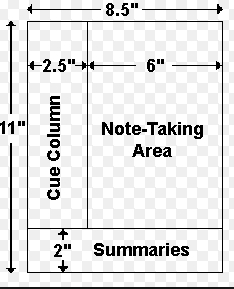 Jeff’s advice is the same advice I received in the “Leveraging the Latest in Brain Science to Deliver the Next Generation of E-Learning” webinar, but it was said differently. Jeff also introduces us to a note taking system developed by Cornell University. Please see the image of what the system looks like. In the Cue Column, you write your main ideas, and the other sections are self-explanatory. I created a template for myself, which I have been using since I first learned about the note-taking system.
I have read close to 80 books for the Virtual Literary World Tour, and not all of them are created equally. In the very good books, there are a plethora of important lessons and ideas. People like Seth Godin and David Meerman Scott consistently generate great ideas, and one of the things they have in common is a love for reading. For the very good books that I read for the Tour, I have a detailed summary of them that I captured using the Cornell Note Taking template I created. Now what I have to do is print the summaries, read them, question myself on the information, start to connect the information in unique ways, and determine what insights emerge during the process.
15 Questions to Activate Your Memory
- What's the book about?
- What are some important themes?
- What are the key concepts?
- What else have I read that's similar to this text?
- What does this remind me of?
- What past experiences have I had with this topic?
- Can I picture in my mind what I'm reading?
- Which part of the text triggered my senses?
- Are there any patterns?
- What clues can I find?
- What is being implied but not explicitly stated?
- What did I learn?
- How has my thinking changed?
- How can I apply what I've learned in new contexts?
- What else can I combine with this for new insight?
Many of these questions are found in Toni Krasnic’s book Mind Mapping for Kids, and these questions are important for repeated retrieval and deep encoding that I talked about yesterday in How to Improve Learning. If I want to remember the great lessons from the important books that I read on the Virtual Literary World Tour, I have to space out the repeated retrievals of the information in the summaries.
Application of How to Remember What You Read
How to Remember What You Read is also a follow-up post to How to Read 30 Books in 30 Days. In that post, I asked readers to read 10 books by the experts in their field, and to read them in relation to each other. Since this information will impact the way you perform your work, it makes sense to capture the information in the Cornell Note Taking System, and review it by asking some of the questions listed above. Imagine the ideas you can introduce into your workplace?
Therefore if you have to learn critical information to assist you in performing your job better, or for any other reason, use the Cornell Note Taking System to capture the germane points, and do not omit the section in the system where you summarize the information – you are writing this in your own words. Retrieve the information from you memory by asking yourself questions, and use the deep encoding method as well, and space out the time between retrievals. This is one process to remember what you read.
Please let me know your thoughts in the comments section below. If you enjoyed this post, please share it.
Book links are affiliate links.